2 September 2026 · Mount
Drop-in engine mounting for a weekend garage — without the junkyard gamble
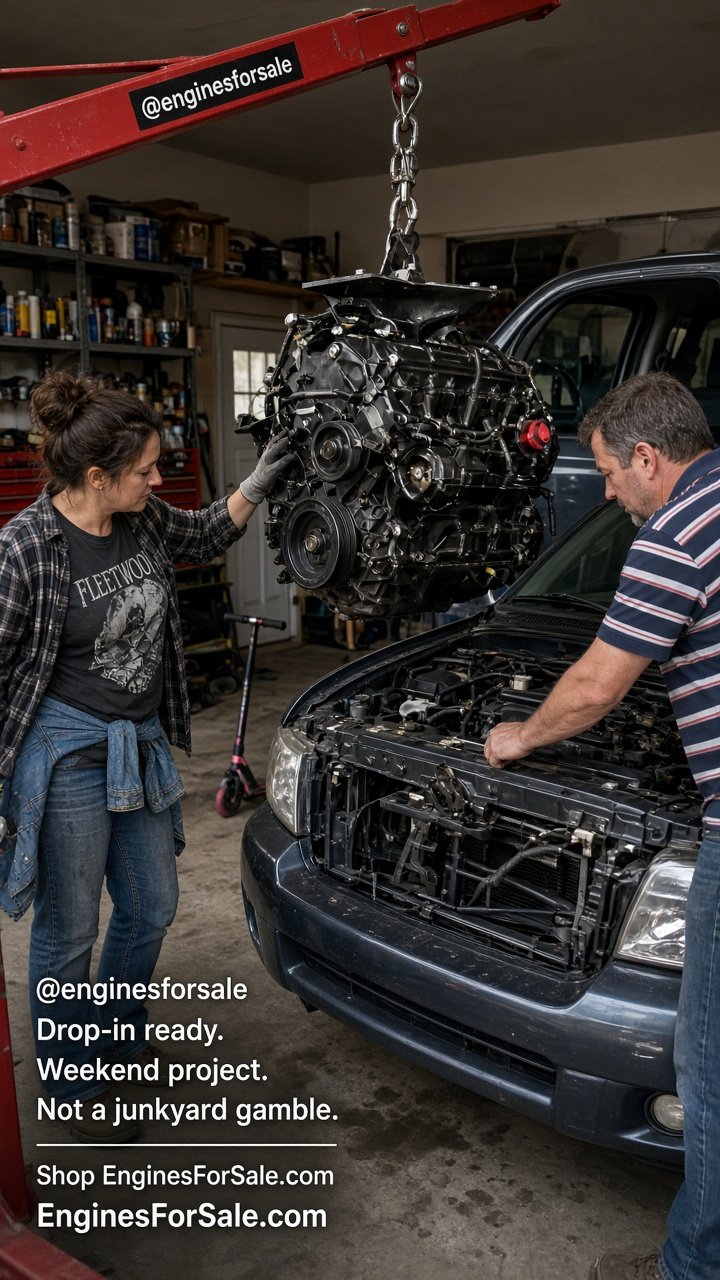
Different clothes, same job: watch the mounts, not the camera.
A hoist day goes well when the mill was a solution before the chain went tight. It goes badly when the bay is being used to discover what you bought. This article sits after uncrating and before accessory assembly. It assumes you already received freight the way we described in how engine freight works. If you did not, go back. Mounting cannot repair a mystery.
Mounting is user experience with gravity
In product design, a good interface does not surprise the hands. A good engine mount day is the same. The engine swap is a known pattern: support the mill, align the mounts, lower, start fasteners by hand. The pattern fails when the mill is the wrong mill, the accessories fight the bay, or one person is both crane operator and fortune teller. Two people in ordinary weekend clothes — a band shirt, a striped polo — is not a gimmick. It is a safer UI: one watches the ear, one watches the hoist.
What “drop-in ready” is allowed to mean
Drop-in is a promise with a border. It means the long-block is the configuration you ordered, not a scavenger hunt of missing brackets. It does not mean zero work. It means the work is listed, not invented. That border is why we care about run-testing before the mill ships: you should not learn about a dead cylinder while the pickup is on stands. A tested reman mill is still an internal combustion engine with habits. It is not a lottery ticket.
Choreography for a red hoist and a real bay
The mill hangs; people do not
Chains on rated points. Level enough that the oil pan is not the first thing to kiss a crossmember. If the mill rotates like a tired animal, stop and reset. This is not the time to “walk it in” with a hip. The person guiding should be looking at the mounts, exactly as in the photo, not performing for anyone in the driveway.
Hands are for alignment, not heroics
Once the mill is close, fingers find holes. Bolts start by hand so you do not cross-thread a Saturday. Torque comes later, in the assembly checklist, with a wrench that clicks and a coffee mug that is not on the fender of the moving object. If a mount hole does not exist, you do not drill a novel. You stop and compare to the order.
The bay tells you when to pause
If hoses, fans, or a forgotten battery cable are still in the hole, the mill will teach you physics. Pause is cheaper than paint. Pause is also how families keep the story as “it ran like it should” instead of “remember when the radiator…”
Takeaway: the hoist is a positioning tool. It is not a test bench.
Shop a mill that is actually meant to drop in
If the listing cannot say what you are getting, the bay will. Start on stock that is built to bolt on — then read the assembly page before you invite helpers.
Prepare the bay like you are shipping a product the other direction
Think of the empty engine bay as a receiving dock. Label the parts you pulled. Bag fasteners. Photograph the old mill’s brackets before it leaves, the same way you photographed the crate in the uncrate guide. That photo set is UX for future-you at 8 p.m. when a bracket looks “almost right.”
Clear the floor. A scooter against the wall is fine; a scooter in the hoist path is how weekends end. Keep kids in a marked zone, the same social contract as uncrating. Parents can run this. They should not run it like a stunt. If you hired a shop instead, send them your crate photos and the ordered configuration so their hoist day inherits your receiving work. You are not being extra. You are handing them a mill that already has a story, which is the whole point of buying reman instead of a blanket on a pallet.
Junkyard gamble vs. drop-in ready
| Bay question | Gamble | Solution |
|---|---|---|
| Do the mounts meet? | Grind, spacer folklore | Match the ordered configuration |
| Do we know it ran? | “Seller said it had compression” | Heard it fire before shipping |
| Are accessories a surprise? | Missing pulley at 6 p.m. | Listed bolt-on work |
| Can two people share roles? | One hero, one phone | One hoist, one mount watch |
| What if it does not sit? | Force it | Stop, photo, call 1-800-ENG-SHIP |
A cylinder block does not care about your optimism. Alignment cares about geometry. Geometry cares about what was remanufactured and what was photographed on arrival. That is a single chain from pallet to this hour.
If the truck is already waiting on a mill
Do not buy a story. Buy a drop-in reman with freight and a test behind it.
Keep reading the path
FAQ
Can two people do this at home?
Many families do, with a rated hoist, a plan, and a mill that is actually the mill. If you do not have the hoist or the nerve, a shop still benefits from a drop-in reman. You are buying fewer surprises either way.
Should accessories be on before it goes in?
Sometimes yes, sometimes no — bay clearance decides. Use the assembly checklist so that choice is explicit.
What if it is not dropping in?
Stop. Photograph mounts and the old reference shots. Call before you modify the truck to fit a maybe.
Is a woman on the hoist “for the photo”?
No. The photo is daily life. Skill is not a uniform. The mill does not check the shirt.
When the mill is sitting on its mounts, you are not done. You are ready for fasteners, fluids, and a first fire that should feel like confirmation — the theme of our testing piece and the family story in real drop-in mills.