28 August 2026 · Shipping
How engine freight shipping actually works for a family garage
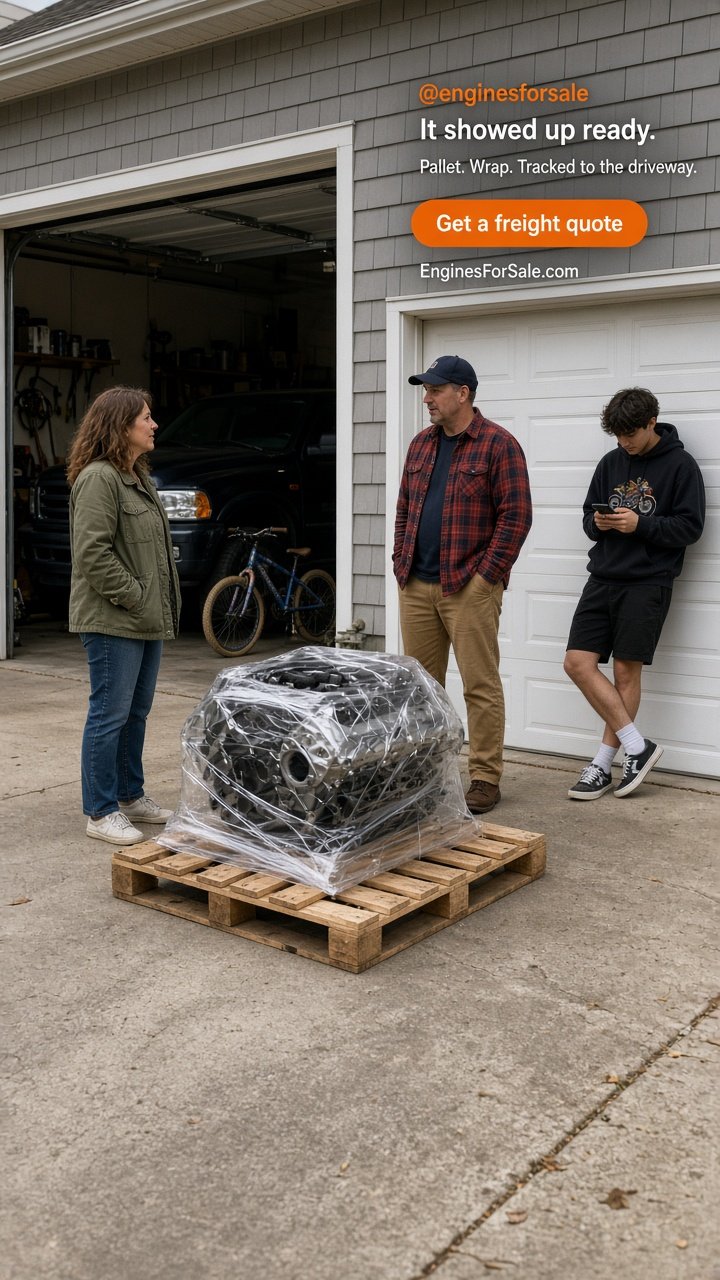
A pallet on the concrete is the first honest product screen. If this moment is confusing, the rest of the install will feel worse.
Most engine anxiety does not start with a torque wrench. It starts in the driveway, when a truck is backing in and nobody is sure whether the mill on that pallet is a solution or a new problem. This guide is the first chapter in our September journal. It is written as user experience for a real household: a parent in a flannel, a partner in a jacket, a teen on a phone, a garage door half up. The job of freight is not “shipping.” The job is to arrive obvious.
The driveway is a design problem, not a logistics afterthought
A remanufactured internal combustion engine is heavy, expensive, and silent until it is in the bay. That silence is the UX gap. Families fill it with stories from forums: cracked pans, missing bolts, “it was a junkyard pull in a blanket.” Good freight closes the gap before anyone opens a crate. If you are already planning the next hour, skip ahead to how to uncrate a shipped engine so inspection sits next to delivery instead of a week later.
What “it showed up ready” has to mean
Ready is not a slogan. Ready is a sequence the buyer can see without calling a stranger. Pallet visible. Wrap intact. Labels readable. Tracking that matches the truck in the street. When those four things line up, the household can move from watching to doing. That is the same calm we want later in drop-in mounting and on run-test day.
The three objects that protect the mill
Freight transport for a long-block is not a cardboard box with a smile. It is a small architecture. If any layer is theatrical instead of structural, the buyer feels it. The architecture we use is boring on purpose: wood, film, strap, paper trail.
Layer one is always the floor
The pallet is the first interface
A pallet is not decoration. It is the handle the forklift understands and the surface a driveway can accept. Fork pockets, decent board thickness, no mystery bounce when the mill is set down — those are usability details. If the pallet fails, every later step inherits a wobble, including the weekend assembly checklist.
Wrap is the weather and the witness
Shrink wrap does two jobs. It keeps road grit off machined faces, and it shows whether anyone opened the pack in transit. Clear film is a feature. You should be able to see that there is an engine in there, not a rumor. Photograph the wrap before you cut it. That photo is for you, and it is for the freight conversation if something is wrong.
Straps and labels are the last quiet controls
Ratchet straps should look like they were tensioned by a person who has done this before, not like a last-minute belt. Labels should survive rain. A tracking number that does not match the dispatch email is a broken button. Treat it that way: stop, call, do not guess.
Takeaway: if you cannot point at pallet, wrap, and strap, the shipment is not done designing itself.
Get the mill on a pallet that is actually tracked
If you already know the engine you need, do not wait for a screenshot from a stranger. Ask for a freight quote with the mill attached to a real dispatch plan.
What to do when the truck turns into the driveway
Delivery day is where most “we’ll figure it out” plans collapse. The driver is on a clock. Kids are watching. The garage is full of the wrong stuff. Design the next ten minutes in advance so nobody improvises with a mill.
- Clear a rectangle of concrete bigger than the pallet. Leave walking space on two sides.
- Have a phone with battery. Tracking is useless if you cannot open the email.
- Photo the truck, the pallet, and the wrap before anyone cuts film. This is the same habit we teach in the uncrate guide.
- If the wrap is torn or the pallet is crushed, document first. Do not “just take it inside and see.”
- Only after the photos: move the mill where the hoist will actually live, which is covered in the mounting guide.
This is wayfinding for a heavy object. You are not being precious. You are preventing a second emergency.
Freight that protects the mill vs. freight that only moves weight
| Question the family asks | Junkyard-style move | Solution-style freight |
|---|---|---|
| Can we see it is an engine? | Blanket, tape, hope | Clear wrap, mill visible |
| Can a driveway accept it? | Odd crate, no fork path | Standard pallet, known footprint |
| Can we prove condition on arrival? | He-said photos later | Wrap + crate photos in sequence |
| Does tracking match the street? | A phone number from 2019 | Dispatch ID that matches the truck |
| What happens next? | Guess and lift | Inspect, then uncrate |
The right column is also a supply chain choice. Reman mills that are remanufactured with a paper trail deserve a paper trail on the dock. That is why we talk about testing before the truck in why run-tested engines matter — freight is the last mile of that promise, not a separate hobby.
Shop a mill that is meant to travel
If you are comparing long-blocks, filter for engines you can actually receive at home or at a shop dock. The product page should make freight a button, not a scavenger hunt.
Read the next hour, not just this one
Shipping is chapter one. Uncrating is how you confirm the chapter was true. Mounting is how the mill becomes a truck again.
FAQ
Can a residential driveway take engine freight?
Often yes, if the pallet can come off the truck with a liftgate or a forklift arrangement you planned. The constraint is space and surface, not magic. Ask for the pallet size with the quote — that is a transactional question, not a trivia question.
Should we be home, or can it sit at a shop?
Either can work. Home is better when the people who will mount the mill will also inspect it. A shop dock is better when you have no liftgate path. Do not mix the two at the last minute.
What if the wrap is torn?
Photograph, then call before you finish signing. Torn wrap is a condition event. It may still be fine. It is not “probably fine” until someone looks with the photos in hand. Continue with the inspect-first uncrate steps.
Does freight replace run-testing?
No. Freight protects a mill that should already have been heard. Read why we run-test before it ships.
If you want the mill, not another tab: call 1-800-ENG-SHIP or email to order. If you want the next decision: open the crate the right way.