31 August 2026 · Unpack
How to uncrate a shipped engine without turning the garage into a crime scene
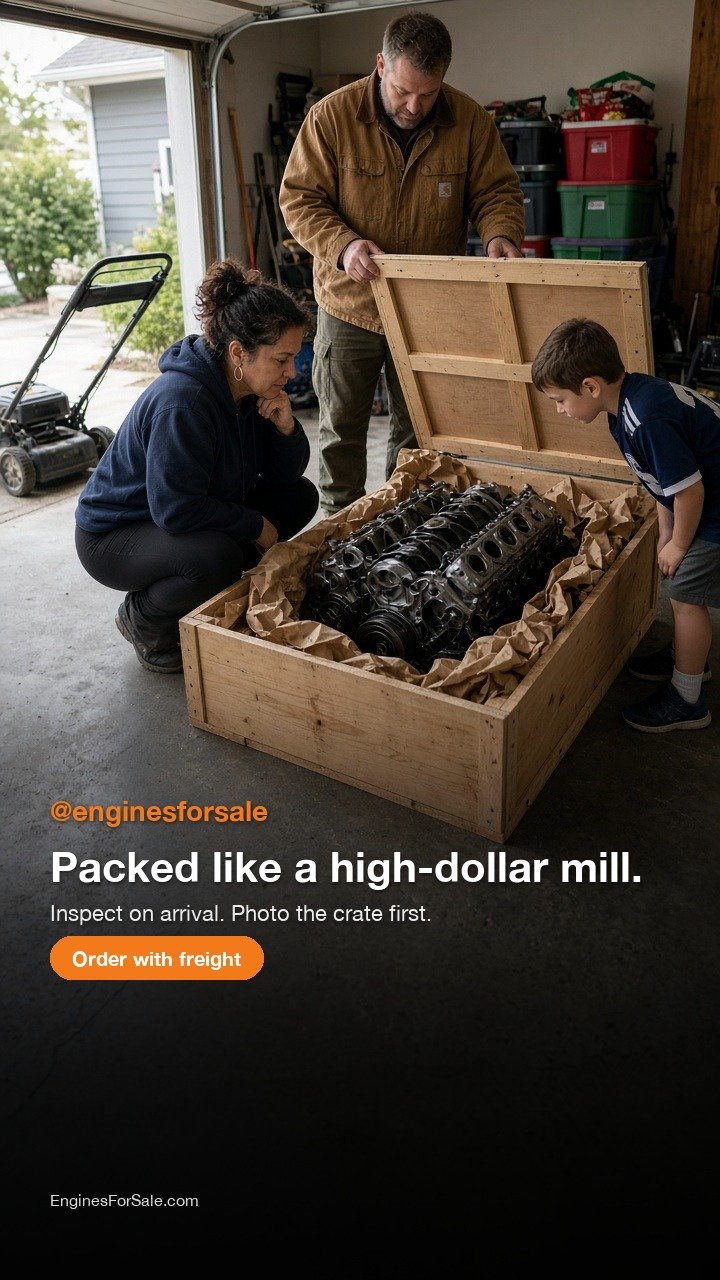
This is the moment kids remember. Design it so the adults can still think.
Uncrating is not a reveal video. It is quality control that the customer finally gets to hold. The mill has already survived freight to the driveway. Your job now is to prove that survival with pictures, then decide whether today is a hoist day. If you skip the proof, you donate your leverage. If you do the proof, the rest of the path — mount, assembly, first fire — stays a project instead of a dispute.
Inspect first is a user-experience rule, not a paranoid hobby
People open crates the way they open parcels: knife, grin, mess. An engine is not a parcel. It is a machined assembly with oil galleries, mounting ears, and a history. The household that treats the crate lid like a receipt will still be friends at dinner. The household that yanks kraft paper while a child is standing in the only camera angle will spend Monday reconstructing what they saw.
That is why the copy on the crate photo is boring on purpose: packed like a high-dollar mill. High-dollar is a packing standard. It is also how remanufacturing should feel when it leaves the building — not like a secret.
The crate is part of the product
Wood, lid, kraft, film: each layer answers a question. Wood says “this was meant to be stacked and forked.” Kraft says “machined faces were not left to scuff the world.” Film says “weather was considered.” If a layer is missing, you do not improvise a story. You document the absence. Then you still have a path into how families actually live with a drop-in mill — because living with it starts with trusting it.
The photo sequence that keeps the weekend intact
Shot one: the closed crate in place
Before anyone owns a crowbar, photograph the crate as it sits after the freight handoff. Include a bit of the garage so scale is obvious. If the driver is still there, even better. Time stamps on a phone are a kind of information architecture: they order the story so you do not have to remember it.
Shot two: lid up, packing still honest
Lift the lid. Do not dive. Photograph the mill in the nest. You should see paper or equivalent dunnage doing a job, not a hollow rattle space. If you can already see a cracked ear or a hanging sensor that should not hang, stop the celebration. The mill can still be the solution. The photos are how you keep it one.
Shot three: the mill after the first lift of paper
Peel packing like you are undressing a patient, not unwrapping a toy. One side, then the other. Photograph mounts, oil pan, and any tagged parts. This is also when you confirm the mill matches what you ordered — the quietest way to avoid installing the wrong story into a pickup truck.
Takeaway: three photos before any hoist chain goes on.
Need the packing standard before you buy?
If you are still choosing a mill, read how it travels and how it is tested. Buying without those two pages is how people end up gambling.
What “packed like a high-dollar mill” should look like in a home garage
Home garages are not warehouses. There is a lawn mower, a bin of decorations, a kid who wants to look. Design the uncrate for that room. Put the crate where the lid can open fully. Keep the walkway. Hand the child a job that is not “stand under the lid”: hold the phone, or stay on the painted line. Parents in ordinary clothes — hoodie, Carhartt, soccer jersey — can still run a professional receiving process. That is the whole point of this journal’s photos.
After the mill is visible and photographed, your next decision is mechanical, not emotional. Either it goes on a stand for accessory assembly, or it goes toward the hoist for drop-in mounting. Do not do both in the same adrenaline spike. Fatigue is how pans get set on a bolt.
A small table for when something is off
| What you see | Do this | Do not do this |
|---|---|---|
| Torn outer film, mill looks seated | Photo, call, then continue inspect | Assume “road rash only” |
| Broken crate corner, packing intact | Photo crate + mill, keep packing | Throw wood away before the call |
| Fresh crack, bent bracket, wet mystery | Stop. Email photos. Wait. | Install “just to see if it runs” |
| Everything matches the order | Move to stand or hoist plan | Leave it on the crate overnight in the weather |
This table is a decision UI. It exists so a family does not have to invent policy at 4 p.m. on a Sunday. If you want the mill behind a proper receiving process, order with freight from a listing that expects these photos. If you want the human version of a good outcome, read bolted in, ran like it should.
Order a mill that is packed to be inspected
Transactional meaning: you are not asking for a vibe. You are asking for a crate you can photograph and a mill you can mount.
Shop engines that are meant to be opened in a driveway
Commercial meaning: pick from stock that already has a path to your concrete, not a maybe.
FAQ
Can a child be in the garage for this?
Yes, with a defined spot and no role in lifting. Curiosity is allowed. Gravity is not a teacher you want.
Do we keep the crate?
Keep it until the mill is accepted and, ideally, until it has been through the first fire. Wood is evidence and, sometimes, a way to send something back without inventing a new box.
When do we put chains on?
After the three photos and a match to the order. Then follow drop-in mounting. Chains are not a receiving tool.
Is this different from shop receiving?
The photos are the same. The room is kinder and more crowded. Design for the room you have.
Next physical step: lower it in without a junkyard feeling. Next human step: see what a calm install looks like.