4 September 2026 · Assembly
A weekend engine assembly checklist that fits a real garage
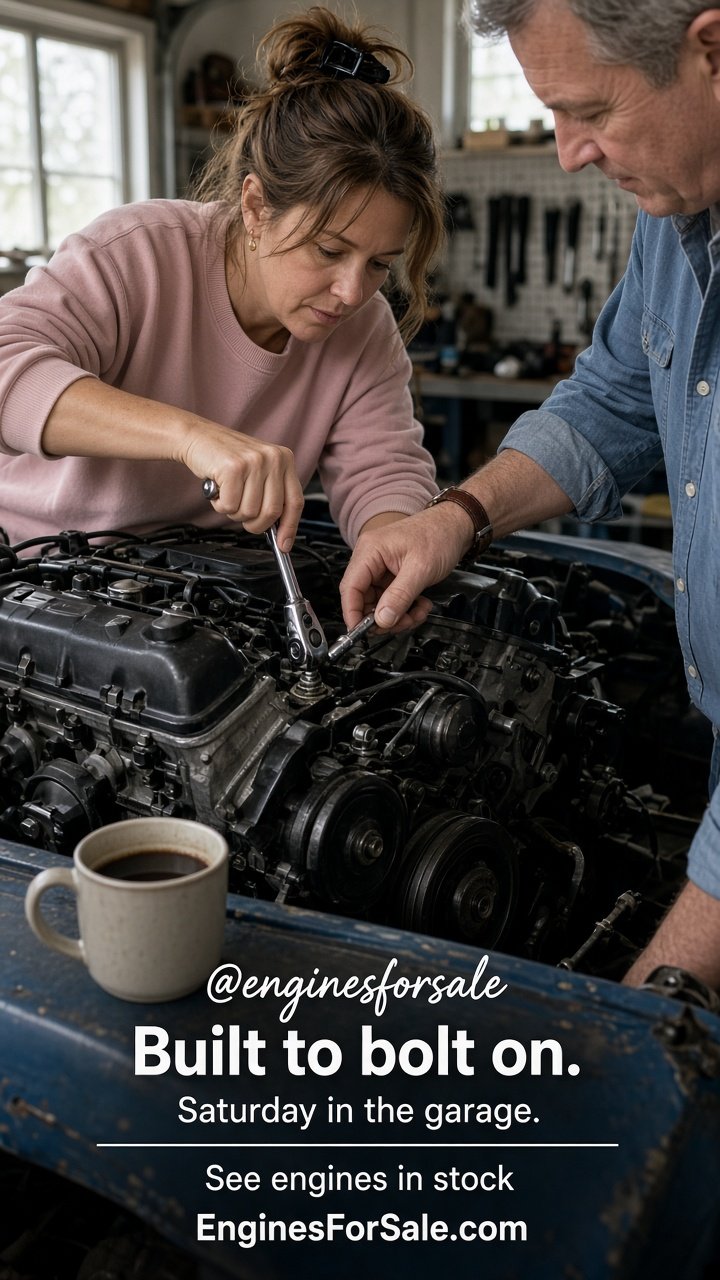
Sleeves up, earrings in, coffee nearby. Assembly is a conversation, not a costume.
Assembly is where a reman mill becomes the engine your truck expects. It is also where weekends quietly die — not from drama, from missing a pulley at dusk. This checklist assumes the mill already survived freight and an inspect-first uncrate. It may happen on a stand before the hoist, or after the mill is sitting. Either way, treat it as a designed session: roles, daylight, a stop time.
Saturday is a user interface
You have limited patience, limited light, and probably a person who did not sign up to hunt 10mm sockets. Good assembly UX looks like a kitchen mise en place: fasteners grouped, intake hardware separate from accessory hardware, the book or printout actually on the bench. A pink sweatshirt and a rolled blue button-down are enough uniform. Skill shows up as passing a socket instead of grabbing. That is the same social design as the family photos in real drop-in mills.
“Built to bolt on” is a parts list, not a mood
If the mill is a solution, accessories are either on it, in the crate, or named as your job. Mystery brackets are how people start inventing. Confirm the configuration against the order before the first click of a torque wrench. If something is absent, that is a phone call to 1-800-ENG-SHIP or an email to order clarification — not a parts-store improvisation that fights the next owner of this truck.
Hands, torque, and who does what
One person torques; one person reads
Cross-talk is how intake bolts get skipped. Give the reader a paper sequence. Give the wrench a clean path. If you only have one adult, put the phone in a bowl and work one subsystem at a time. An internal combustion engine does not reward multitasking.
Start fasteners by hand, always
The click of a wrench is a later chapter. The first chapter is threads that agree. If a bolt fights, back out. Fighting is data. Data belongs in the same photo habit you used on the crate — a close-up now saves a theory later, especially if the mill still has to go through your own first fire after a factory run-test.
Coffee is allowed; coffee on the mill is not
A mug on the fender is human. A mug on the intake is how sugar meets throttle body. Put drinks on the toolbox. Put rags where they cannot be left in a pulley. Household rules scale to engines if you bother to say them out loud.
Takeaway: assembly is a checklist with a clock, not a vibe.
A sequence that fits daylight
| Block of work | Why this order | Done looks like |
|---|---|---|
| Confirm mill vs. order | Stops installing the wrong story | Tags and photos match |
| Mount-related brackets | Needed before or during hoist work | Holes meet without force |
| Intake / sensors you can reach | Easier on a stand | Connectors seated, no leftover pins |
| Accessories and belts | Clearance decides on/off the truck | Pulleys aligned, belt path obvious |
| Fluids and first-fire prep | Belongs with testing discipline | Oil in, no dry start plan |
This table is not a shop manual for every platform. It is information architecture for a family garage: what must be true before you invite more helpers. Platform specs still win. The table keeps you from mixing “fun bolt-on” with “we needed that bracket two hours ago.” If a helper arrives eager and unbriefed, give them the table before a socket. Enthusiasm without a sequence is how belts go on backwards and how a calm Saturday becomes a parts-store run you did not budget. The mill is already the solution. Assembly should not reopen the gamble.
See mills that are spec’d to bolt on
If the product page cannot tell you what is included, assembly will. Shop stock with a configuration you can actually finish on a Saturday.
Stop rules that save the truck
Stop if a hole does not exist. Stop if a sensor is broken in the pack — that is a receiving issue from uncrate day, not an assembly dare. Stop when the light goes or when one person is hungry enough to get sloppy. A reman mill from a remanufacturing process deserves the same patience the factory (or the reman cell) already spent. You are not racing a junkyard clock.
When the session is over, cover the mill. Bag the leftover fasteners by subsystem. Tomorrow-you is a user with less context. Leave them a note. That is customer experience for your own household, which is the whole tone of today’s full-path piece.
Need the mill before next Saturday?
Ask for a configuration you can assemble, freight you can receive, and a test you can believe.
Related reading
FAQ
Do we assemble on the stand or in the truck?
Whichever gives clearance and backups. Stands are kinder to intakes. Bays are the truth for accessories that fight fans and cowls. Decide before lunch, not after.
What torque spec do we use?
The one for your fasteners and platform, not a forum average. If you do not have it, you do not guess in aluminum.
Can this be a parent-and-teen job?
Yes, with the teen on reading, photographing, or fetching — not on supporting a mill. Keep gravity adult.
When is assembly “done enough” to fire?
When fluids, filters, and the no-dry-start plan are real. Read run-tested before it ships so your first fire is confirmation, not discovery.
The click of the last fastener is not the end of the product. The first clean idle is. That is why the next article in this September set is about testing, and why the hub post puts assembly in the middle of a path instead of a pile of tabs.